
Platform / Architecture
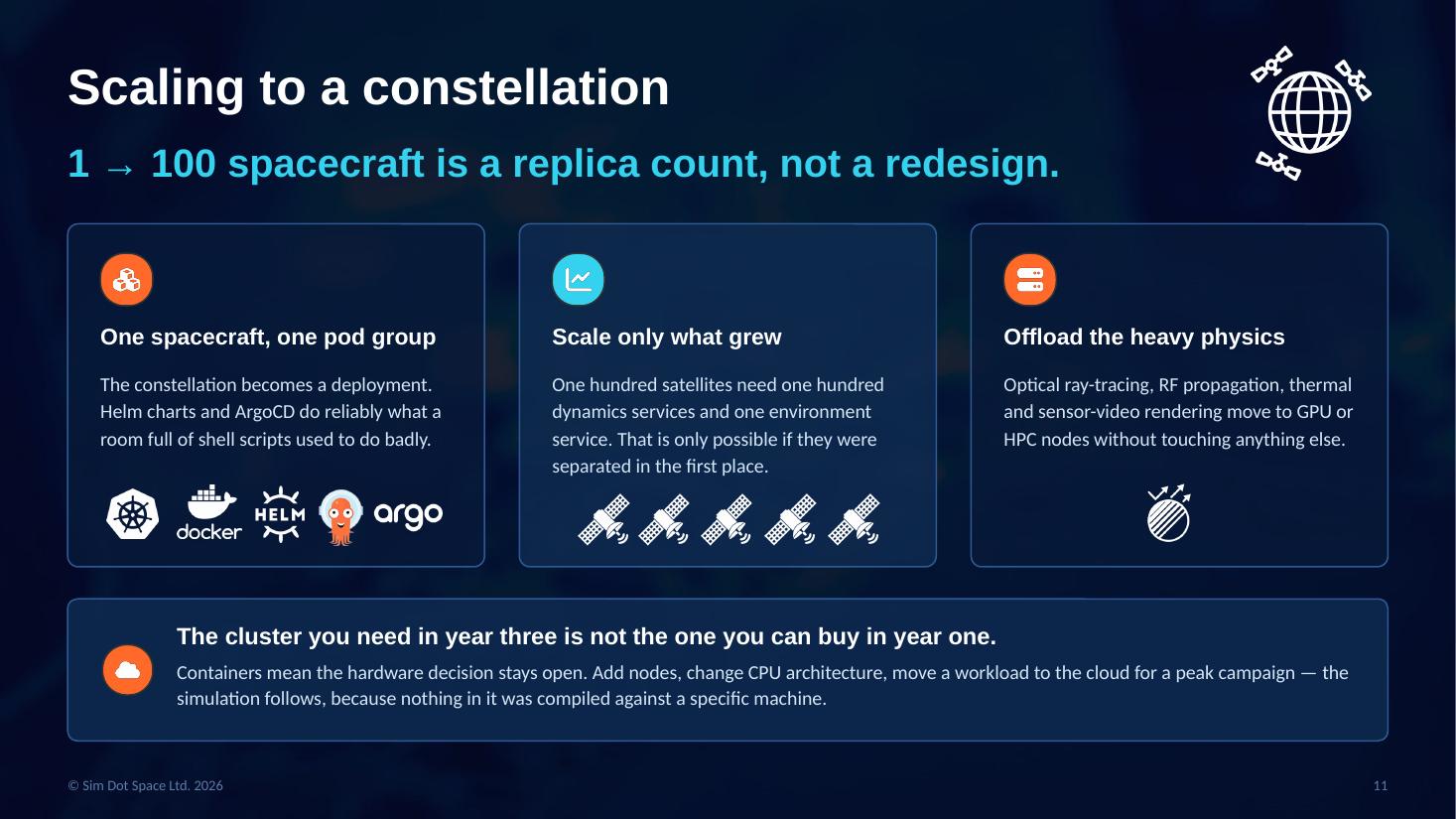
1 → 100 spacecraft is a replica count, not a redesign
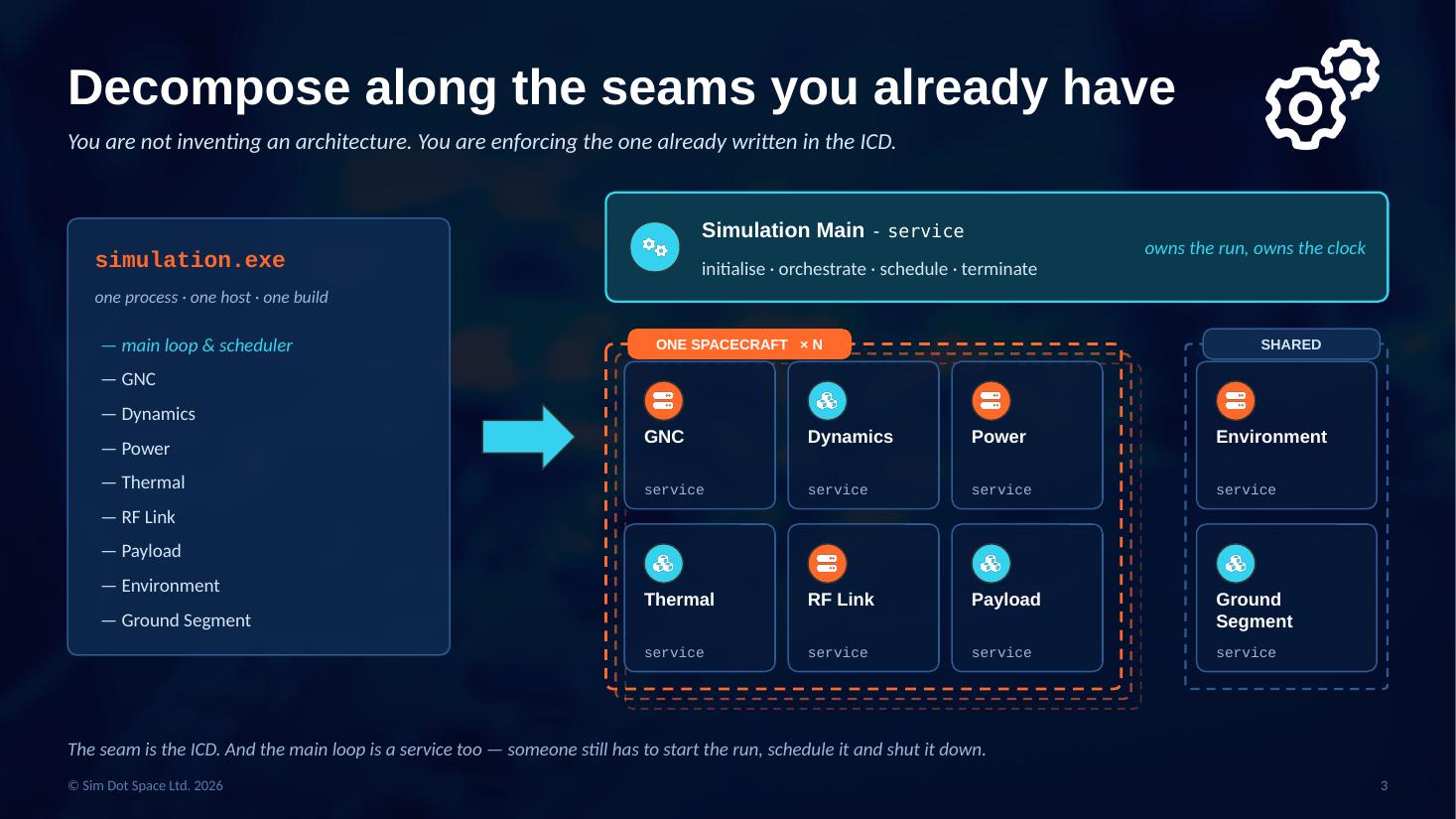
A simulation built from services instead of one executable: independent builds, any hardware, and capacity decided late instead of guessed early.
Why monolithic simulators hit a wall
None of these are modelling problems. They're packaging problems, and packaging can change.
One build
Change one model and you rebuild, and re-verify, all of them.
Scale everything
100 spacecraft means 100x the whole simulation, not just the parts that grew.
Integration is a build problem
Foreign models must compile into your tree, your OS and your CPU architecture.
Hardware frozen at kickoff
Simulation hosts are sized years before anyone knows the load.
The seam is the ICD
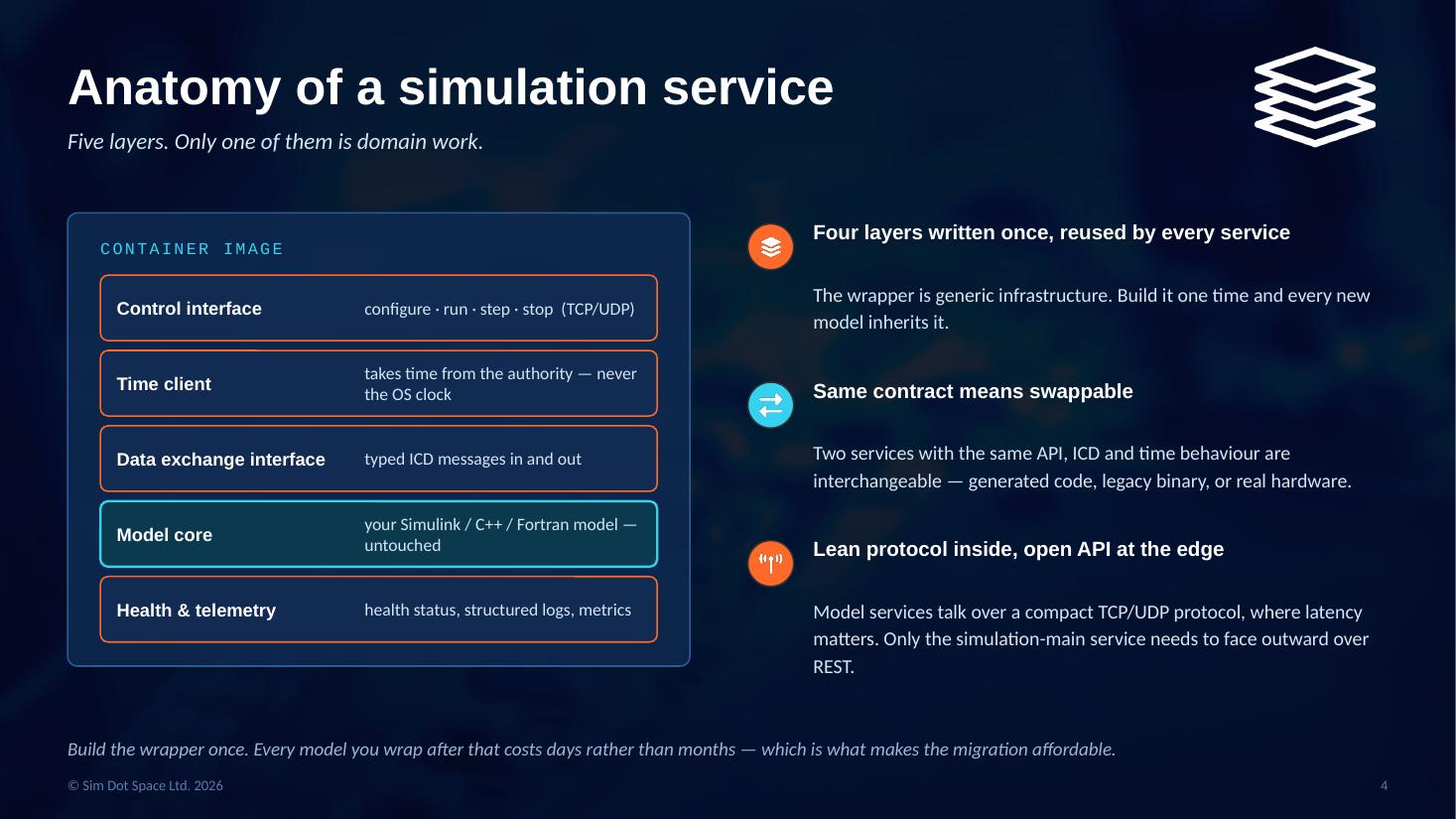
Each model runs as a service inside a generic wrapper: control, time, data exchange and health. Only the model core is domain work, and it stays untouched.
- Lean TCP/UDP protocol inside the loop, where microseconds count
- Open REST API only at the edge, on the simulation-main service
- Same contract means swappable: generated code, legacy binary or real hardware
Wrap, don't rewrite
Asset portability is the fastest return on this architecture.
Export
Simulink, C++, Fortran or legacy code, as it is.
Wrap
A thin adapter maps ICD messages and the time contract.
Containerize
Toolchain, libraries and licence pinned inside the image.
Publish
A versioned image in the registry is a model release.
Supplier ships only a binary? It runs in its own container, OS and CPU architecture. You never need their source.
The hard parts, solved
Time, data and recording are where distributed simulation efforts fail. They're built into the platform.
Time
One central time authority with three modes: real-time for HWIL, step-synchronized for SIL and faster-than-real-time runs, and rate-regulated for mixed-rate constellations. No service ever reads the OS clock.
Data
Separate planes for control, telemetry and high-rate model I/O. Versioned ICD schemas fail fast at startup, not at T+400 s with a silently wrong quaternion.
Recording and replay
Central logs and metrics, Kafka as the recording tape, recording rate adjustable mid-run, and bit-identical re-runs in deterministic mode.
A run you cannot replay is an anecdote. A run you can replay is a test.
Scale only what grew
- One spacecraft, one pod group, deployed with Helm and ArgoCD
- 100 satellites need 100 dynamics services and one environment service
- Ray-tracing, RF propagation and sensor rendering offloaded to GPU or HPC nodes
- Hardware stays an open decision: add nodes, change CPU, burst to cloud, or run fully air-gapped
Don't reinvent the wheel
Wrappers, time authority, recording control and orchestration are plumbing every programme needs and no programme is differentiated by. Teams spend years building it and rediscovering the same failure modes. License a proven stack, and spend your engineers on the models that are actually yours.
See it on a mission like yours
A 30-minute live demo, online or at our next event. Not ready to talk yet? Take the 2-minute architecture audit.