
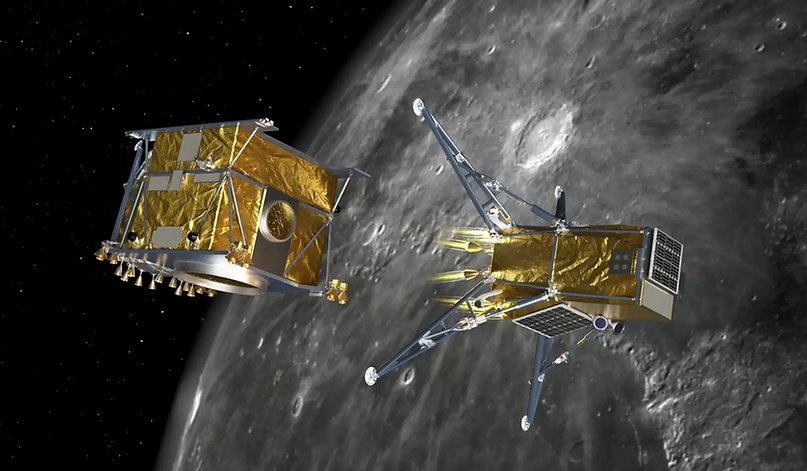
SpaceIL's Beresheet 2 mission marked a step forward toward a successful lunar landing: the team completed a simulated landing process developed in collaboration with Sim Dot Space, whose two founders were also involved in the Beresheet 1 mission.
"The simulation we conducted included all stages of the autonomous landing, from detachment from the mother spacecraft at an altitude of 40 kilometers above the lunar surface to a successful touchdown, with all landing parameters carefully modeled by the simulator."
So said Moshe Medina, Director of the Beresheet 2 program, in an interview with the Davidson Institute. "So far, the simulation has only been run on a computer. In the coming months, we will begin integrating the simulator into our hybrid lab, where we will test and validate components and systems of the landers themselves."
Beresheet 2 plans to place two identical landers on the Moon, one on the near side and, if all goes well, one on the far side, while the mother spacecraft continues its mission in lunar orbit. The first simulation covered a near-side landing under nominal conditions and also served to calibrate and verify the simulator itself.
"In future stages, we will run simulations of more challenging landings and various malfunctions, such as sensor failures. One of the lessons from Beresheet 1 was the importance of starting simulations in the hybrid lab as early as possible."
Image: Weizmann Institute / Ettay Nevo. Quotes from Moshe Medina's interview with the Davidson Institute.
Satellites, constellations and landers
Next: Inspired by the next generation of Israel's space industry
See it on a mission like yours
A 30-minute live demo, online or at our next event. Not ready to talk yet? Take the 2-minute architecture audit.